European agriculture faces unprecedented challenges related to climate change. How can we build a more resilient agricultural sector? This crucial question was at the heart of the webinar organized by European projects HelEx and Booster on December 9th, 2025, unveiling scientific innovations that redefine the future of agriculture.
1. Genomic editing for resilient agriculture
A population-wide approach to discover functional cis-regulatory variation in crops
Researchers from the Booster project, led by Dr. Thomas Hartwig, Group Leader at Max Planck Institute for Plant Breeding Research and CEPLAS (Germany), are revolutionizing our understanding of genetic mechanisms of drought resistance. Their work focuses on three strategic species:
- Maize, an essential food crop but highly sensitive to water stress
- Teff, an African superfood naturally resistant to drought
- Lovegrass, a “resurrection” plant capable of surviving after losing 95% of its water
The strategy used in BOOSTER to identify cis-regulatory variations and their functional effects uses MoaSeq technology to map high-resolution binding sites of transcription factors. This technique allows identification of over 200,000 potential genetic regulation sites across the maize genome, opening unprecedented prospects for varietal improvement.
A multiplex genome editing approach to modulate cis-regulatory elements
Dr. Hilde Nelissen, Group Leader at the VIB-UGent Center for Plant Systems Biology (Belgium) develops multiplex genomic editing strategies to modulate cis-regulatory elements. This approach enables comparing and modulating cis-regulatory elements in maize, teff and nindensis, including:
- Selective excision of regulatory elements in sensitive lines
- Insertion of improvement elements from resistant species
- Multiplexing modifications to target multiple genes simultaneously
The objective: transfer the natural resilience of lovegrass to maize and teff, thus creating varieties adapted to increasing drought conditions.
2. Natural biostimulants: innovation from sea and soil
Enhancing abiotic stress tolerance of major food crops using priming agents
The Booster project also explores a complementary approach through the development of natural biostimulants. Prof. Dr. Zerihun Tadele, Group leader at the Institute of Plant Sciences, University of Bern (Switzerland) coordinates a massive collection of microorganisms from European and African arid soils as part of BOOSTER strategies to improve drought tolerance in maize and teff:
- 1,000 isolates collected from 14 European locations
- 300 strains sampled from 12 Ethiopian sites
- 150 samples from South Africa
Analyses reveal a dominance of Actinobacteria, Pseudomonadota, and Bacillota phyla in these extreme environments. These microorganisms, selected for their ability to promote growth under stress conditions, form the basis of innovative formulations.
Next Steps in BOOSTER: Field-scale validation of biostimulants
BioAtlantis, an Irish company specializing in biostimulants, develops formulations based on brown algae extracts. Preliminary results demonstrate:
- Significant improvement in germination of treated seeds
- Increased primary root length
- Superior yields of 20-25% under water stress conditions
Dr. Sujeeth Neerakkal, Head of Plant Research at BioAtlantis Ltd (Ireland) specifies that 16 different formulations have been tested, with identification of three promising candidates for scaling up and validating biostimulant technologies across EU and Africa.
3. Artificial intelligence and environmental assessment
Employing AI to assess the environmental impact of sunflower cultivation
The HelEx project integrates artificial intelligence to anticipate the evolution of European agriculture. Dr. Ralf Wilhelm, Head of Institute / Institute for Biosafety in Plant Biotechnology uses artificial intelligence to analyse agricultural environmental impacts, including sunflower cultivation trends.
This approach reveals complex regional dynamics:
- Expected decline in certain Mediterranean zones due to drought
- Possible expansion in Germany and northern France
- Stability in Balkan regions, current major producers
AI enables identification of hard-to-access information sources (grey literature, local agricultural recommendations) and anticipation of crop rotation changes.
Advanced pollinator detection methods in farmland
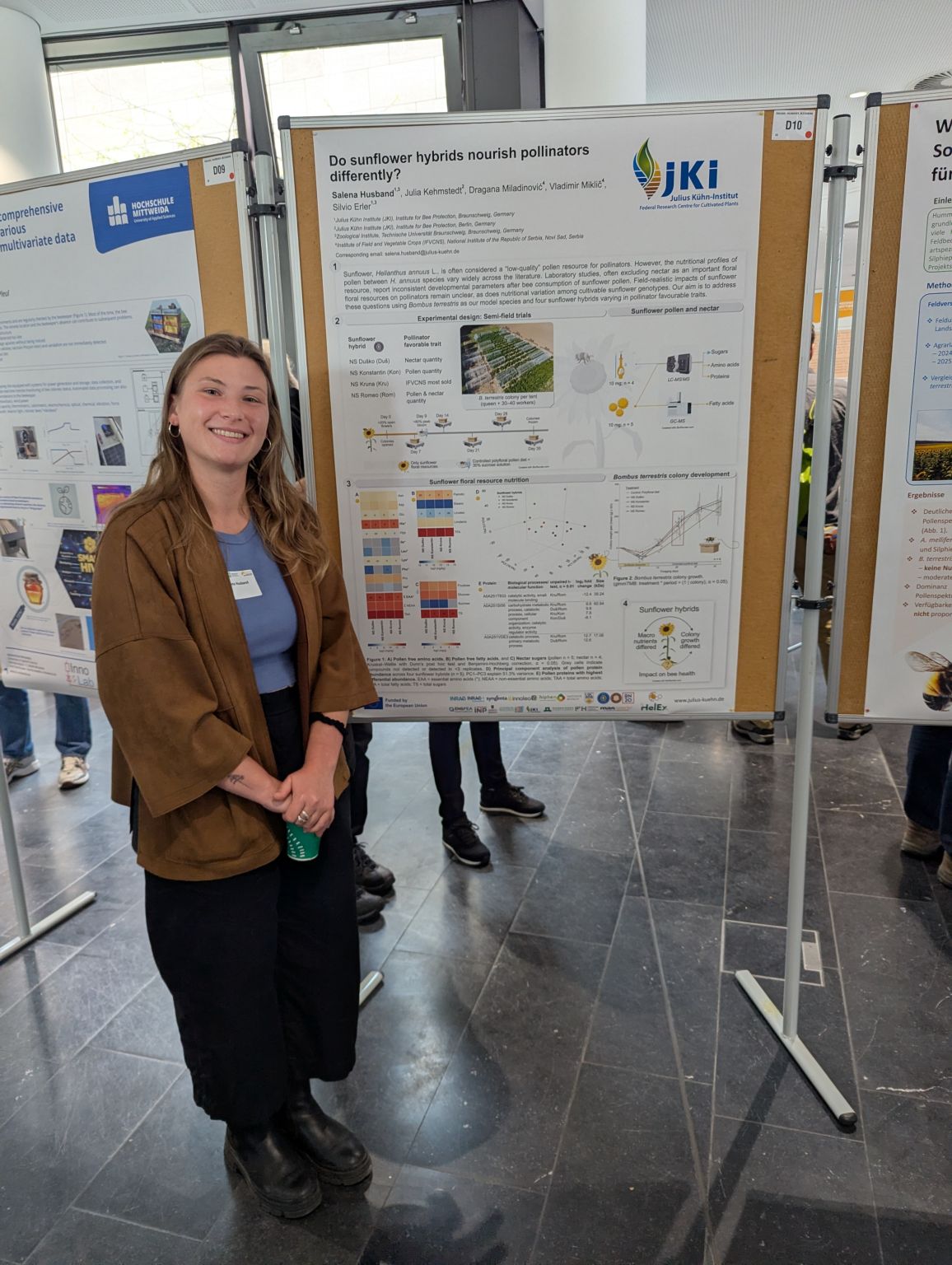
Ilja Svetnik, Lecturer in Science Communication & Outreach Officer / Science Researcher at Carinthia University of Applied Sciences (Austria) revolutionizes pollinator monitoring with DNA-metabarcoding for faster and more reliable pollinator monitoring. This approach enables:
- Molecular identification of over 90% of species detected by traditional morphological analysis
- Systematic sampling with colored traps (blue, yellow, white UV)
- Massive analysis of 648 samples from three European countries
Initial results show marked differences between countries: predominance of bumblebees in France, honeybees in Germany, confirming the importance of regionalized approaches.
Towards a transformed European agriculture
Innovation timeline
Researchers estimate these innovations could reach the market within 2-3 years for biostimulants, still requiring regulatory approval phases. For genomic editing, commercial applications are envisioned within 5-7 years, allowing time to validate approaches and transfer them to commercial lines.
Expected economic and environmental impact
The HelEx and Booster projects aim for significant improvements:
- 20% reduction in drought-related yield losses
- Improved nutrient use efficiency
- Preservation of ecosystem services (pollination, biodiversity)
- Adaptation to Europe’s future climate conditions
Tomorrow’s agriculture takes shape today
These European research initiatives demonstrate that agricultural resilience no longer relies on mere hope but on rigorous scientific approaches. Between precision genomic editing, natural biostimulants, and artificial intelligence, European agriculture now has concrete tools to adapt to climate change.
Discover the full webinar here: